
Binance through the Finandy trading terminal with advanced capabilities
Finandy connects to Binance via API and becomes its logical continuation. You trade in the Binance ecosystem, but with an intuitive interface, advanced tools and trade control
100,000+
traders trust Finandy
since 2017
in the crypto trading market
$75+ million
daily turnover of our users
Finandy
improved version of Binance for trading
Trading terminal for Binance, which connects to the exchange via the official Binance API. You do not transfer funds or create a new account.
Your money, account, and security remain in your secure Binance account.Finandy only receives the rights to carry out transactions through the official API key. This is a standard and safe practice approved by the exchange.
Finandy gives you a different level of work: more control, a clear structure of transactions, advanced orders and analytics in one interface.

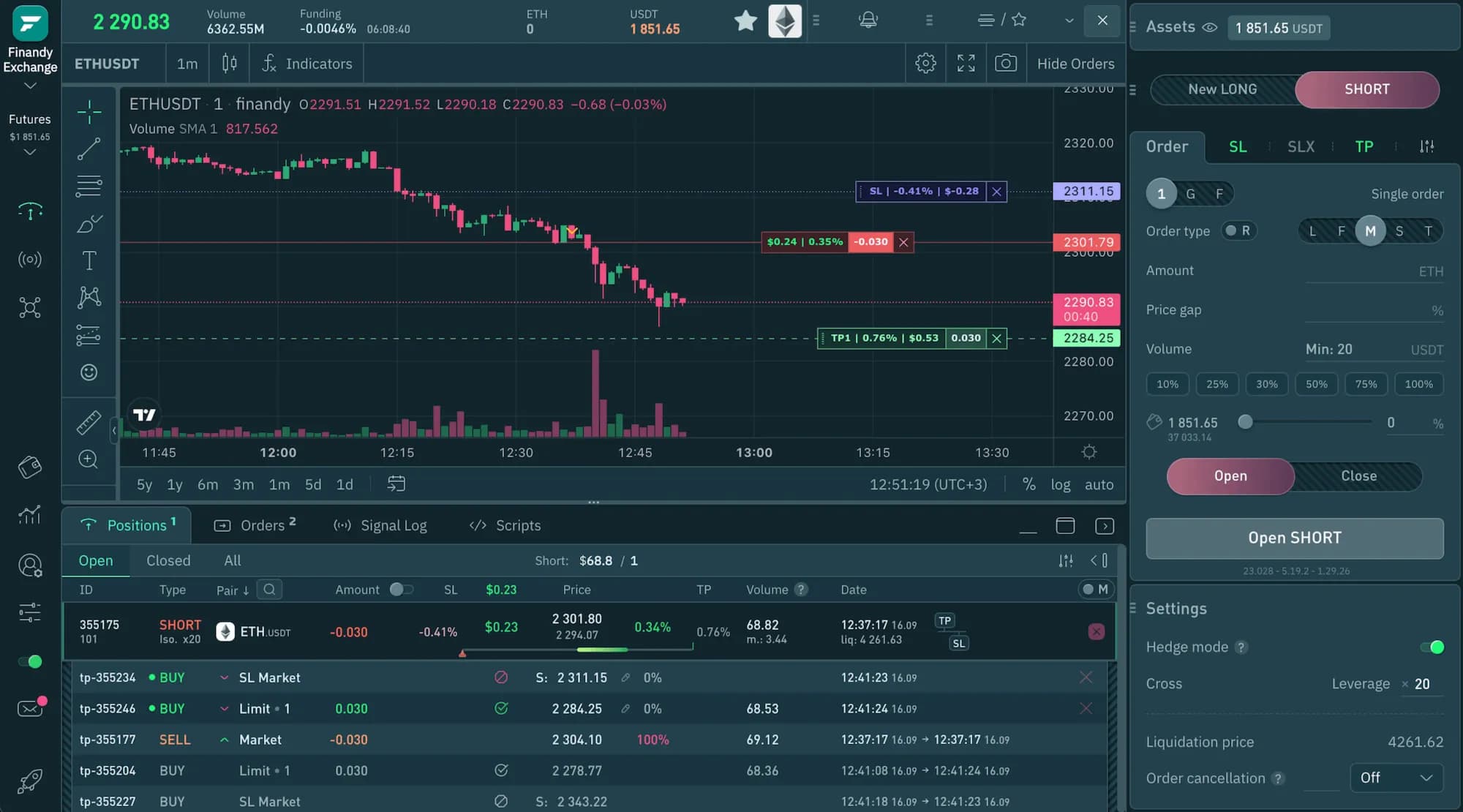
Why is trading through the terminal more effective than trading directly with Binance?
The Binance interface is designed for the mass user. Finandy - for those who trade regularly, use strategies and calculate the results
The deal structure has become clear and unified
Instead of separate tabs, Binance has a single workspace: trades, active orders, open positions and transaction history are collected in one overview screen.
Risk control and strategic analytics
You see not just transactions, but the whole picture: profitability by strategy, current drawdowns, risk distribution over the deposit.
More tools for real trading
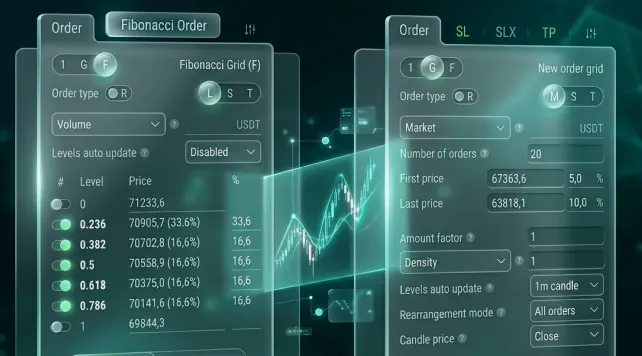
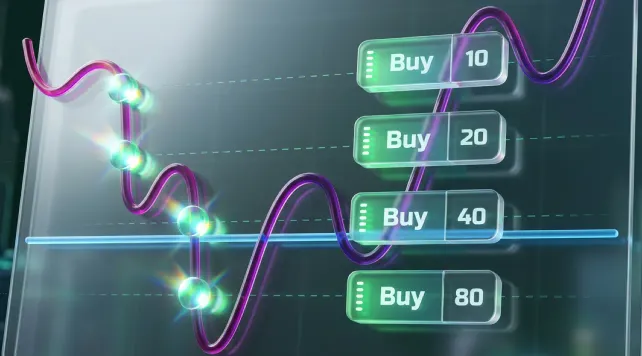
Advanced orders
An expanded set of orders and their management on the chartEntry and Exit Scripts
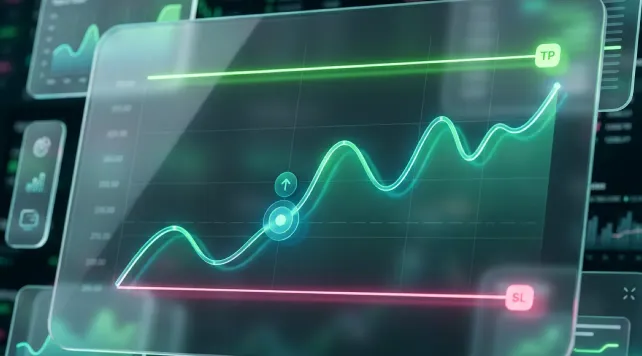
Complex installation of take profit and stop loss from one pointTactics
Trading using a ready-made strategy, not “by buttons”Binance vs Finandy
The Binance interface is designed for making trades. Finandy is designed to manage trading and risk on Binance.
Finandy (your interface)
Binance (global player)
You store funds on Binance. You work at Finandy
Start connectingHow does connecting to Binance work?
You trade from your Binance account. Finandy does not store your funds and does not have access to withdrawals. The terminal only works with API trading rights
Connection takes 3–5 minutes
Create an API key on Binance
Copy it in Finandy
Select Binance from the list of exchanges
Open the terminal and start trading
Connect Binance to Finandy in 5 minutes and get all the benefits you just saw
For whom the bundle was created Finandy + Binance?
For traders,who find it difficult to fit into the standard Binance interface
For those who trades regularlynot sporadically
For those who workswith strategies and risk control
For Binance users,who want more control, speed and consistency
Security and official Binance outline

Answers to questions about trading on Binance through the Finandy trading terminal
Is this a replacement for Binance?
Is it suitable for beginners?
Is it safe?
Can I use it from my phone?
How much does it cost?
How quickly are orders placed?
Cryptocurrency exchange 2026: how not to get lost in the choice and not overpay on commissions
Binance has long ceased to be just a site where people buy bitcoins. Today it is a large cryptocurrency platform, within which the user can trade, store assets, conduct P2P transactions, connect an application, work with Web3 services and use dozens of tools for various tasks. If you go to binance.com now, it is not a classic exchange in the old sense of the word. This is an ecosystem. Spot market, derivatives, binance p2p, wallets, internal transfers, tokens, NFTs, Web3, dApps. In terms of trading volume, Binance has held the position of the world's largest crypto exchange for many years. Transactions worth tens of billions of dollars are processed through the platform every day. For millions of users, binance became the first point of entry into the cryptocurrency market. Here they make their first purchase, their first sale, create an asset, and test the trading interface. And at about the same moment, a feeling of overload appears. As long as the operation is one-time, this does not interfere. But when trading becomes a process, the standard exchange interface becomes limiting. ## How Binance appeared and what it has become
Binance was launched in 2017 as a developer product for the rapidly growing cryptocurrency trading market. By 2020, the platform served users from dozens of countries, and its daily turnover amounted to billions of dollars. Further growth began not only in volumes, but also in structure. In 2022 and 2023, the exchange actively expanded the ecosystem: strengthened the P2P direction, developed Web3, launched individual applications, added services for storing, transferring and working with cryptocurrency. At this point, binance ceased to be just a trading platform and became a platform. At the same time, the logic of use has also changed. There are more opportunities. The interface has become more complex. Many scenarios appeared, but the whole picture disappeared. ## Binance and restrictions for users from Russia
After 2022, the situation for the Russian market has changed. Binance announced new restrictions related to EU sanctions and the general EU policy against Russia. In March 2023, and then in August 2023, the exchange gradually introduced restrictions on working with certain currencies, instruments and payment methods. Because of this, the wording “Binance closed for Russians” stuck in searches. Formally, the platform did not leave the market completely. But the opportunities for users from Russia have really decreased. Direct transactions with the Russian ruble, payments in euros, and some financial instruments and services have become unavailable. This affected not only trading, but also deposits, withdrawals and sales of assets. The issue of P2P and fiat transactions has become especially sensitive. ## P2P, ruble and practice of working through the exchange
Amid Binance's restrictions, p2p has become a key channel for many users. Through the P2P platform it was possible to continue to work with the Russian ruble, use alternative payment methods, conduct transactions through intermediaries and the regional market. After April 21, 2022 and the introduction of the tenth package of EU sanctions, P2P has long remained the most flexible mechanism within the crypto exchange. But P2P has a downside. This is not a trading terminal, but a service for transactions between users. Each operation is a separate check, correspondence, waiting, monitoring conditions. The user remains in the binance infrastructure, but takes on some of the risks. Therefore, P2P solves the access problem. But it does not solve the problem of convenient and systematic trading. ## Why the standard Binance interface is becoming insufficient
The binance interface was originally designed to be universal. It should suit everyone. For beginners, investors, active traders. Because of this, it is full of features, but poorly tailored to work scenarios. When a user has several assets, transactions begin to occur regularly, and trading turns into a process, the same difficulties arise:
— deals and history are scattered across the screens — it is difficult to control the risk and the overall result — there is no complete picture of operations — fragmented analytics — the trading process is tied to manual actions
At this point, many begin to look for a tool that works on top of the exchange. ## Trading terminals and Binance: connection logic
The trading terminal is an external tool that connects to binance via the API. The user creates keys in the exchange’s personal account and transfers to the terminal the right to carry out trading operations. The funds remain on the binance side. The terminal does not access the output. Asset storage, security, compliance with legal requirements - all this remains within the scope of the crypto exchange. In fact, the terminal becomes an add-on. It doesn't replace the platform, but rather changes the way you work with it. ## Why users connect terminals to trade via Binance
The main reason is control. Through the terminal, the user sees not just a chart, but a structure: assets, transactions, risk, history, result. Trade ceases to be a set of operations and becomes a system. Terminals allow:
- work with several markets at once
- manage orders from one interface
- see the real picture of the deposit
- analyze the result not by one transaction, but by strategy
- perform transactions faster
This is especially important in conditions of high volatility of the cryptocurrency market, when the price changes faster than the standard interface allows you to react. ## Safety, regulators and official statements
Binance regularly appears in statements from regulators and government officials. The US Department of Justice, EU financial institutions, industry agencies and major media outlets, including The Wall Street Journal, have repeatedly discussed the platform's activities, its role in the cryptocurrency industry and regulatory issues. In July 2023 and earlier, in March 2023, binance announced an adjustment to its work policy in certain regions. These changes affected users, currencies, transactions and financial instruments. In practice, this means one thing: the platform is developing under constant pressure from legislation. The interface and rules are changing. And the more complex the market becomes, the higher the value of tools that help the user build their own trading logic on top of the exchange. ## Binance today: market infrastructure
Today binance is an infrastructure. Crypto exchange, P2P platform, Web3 platform, storage service, application, trading gateway. Millions of users, billions of dollars in turnover, hundreds of types of tokens and cryptocurrency assets pass through it. Users can trade, store cryptocurrency, transfer funds, use Web3 applications and connect external tools. And increasingly, such a tool is becoming a trading terminal. ## Why the Binance + terminal combination has become the norm
Binance solves the problem of market access. The terminal solves the control problem. The exchange is a platform. The terminal is a tool. The link allows the user to remain in the familiar Binance infrastructure without losing security and liquidity, but at the same time receive a more convenient, visual and manageable trading process. This is why many who started with the binance application eventually move on to trading through the terminal without leaving the platform.